


Join Kirk and Friends TONIGHT for a Discussion About "Pride!" with Warriors for Life (WFL)

Come join Volunteer, Peer Support Specialist Kirk Poe for "Awaken Your Inner Healer!" edition of Warriors for Life (WFL) Online, sponsored and presented by Victory for Veterans, Inc. (VFV).
We are asking everyone to share who we are and the support that Victory for Veterans, Inc. (VFV) provides through Warriors for Life (WFL). If you know someone who is a veteran, first responder or a family member/caregiver, please ask them to join us for at least one meeting so they can learn more about what we do and how they can share their wisdom with others who may be able to learn from them.
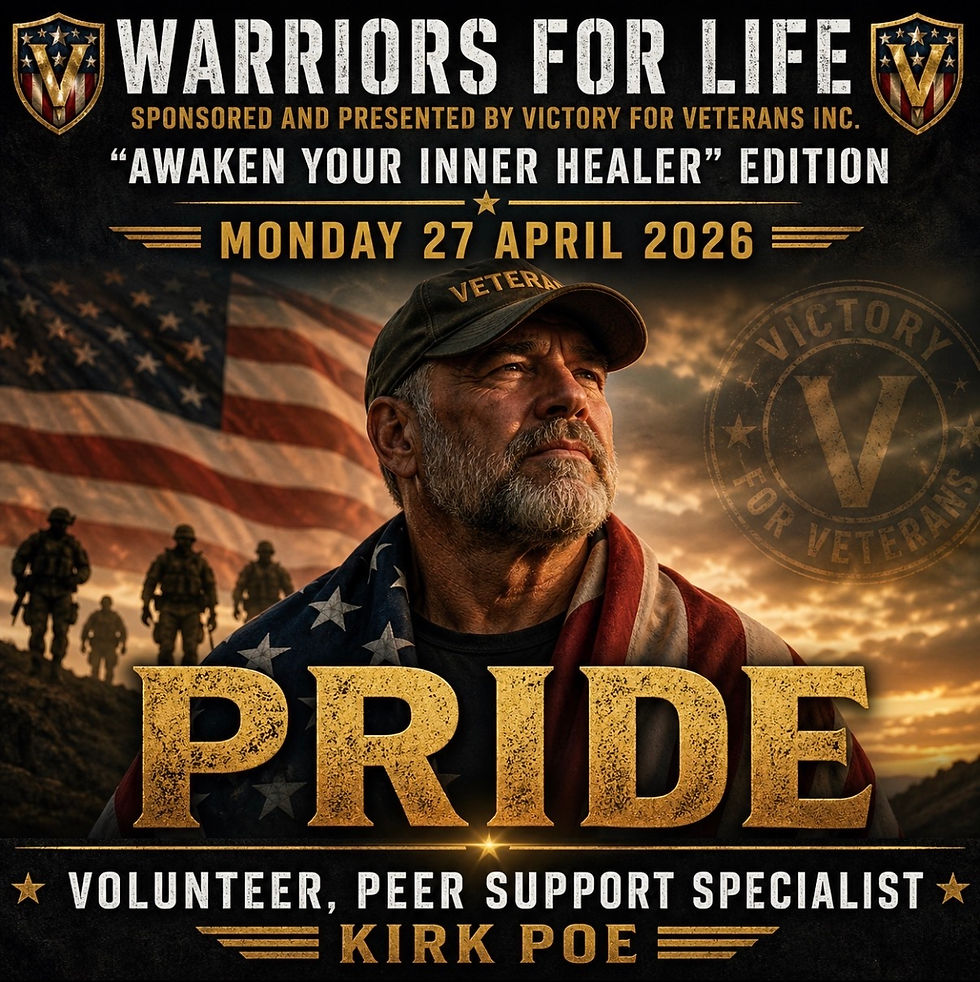
TONIGHT's Topic: "Pride!"

Join Kirk and Friends, TONIGHT and let's get together online for the Warriors for Life (WFL) as we discuss "Pride!" and mental health. How does "Pride" affect your mental health or invisible wounds?

Pride is a dual-edged sword for those in high-stakes, service-oriented professions. It is often the very quality that enables someone to run toward danger, yet it can become the primary barrier to healing once the uniform is removed or the shift ends.
The Impact of Pride on Invisible Wounds

For those dealing with PTSD, TBI, or MST (Military Sexual Trauma), pride often manifests as a "protective shell."
Invisibility vs. Identity: Because wounds like TBI or PTSD aren't always visible, pride creates a pressure to "look the part" of the unbroken warrior. This often leads to masking, where the individual exhausts themselves trying to appear unaffected.
The "Weakness" Fallacy: In service cultures, needing help is frequently misidentified as a lack of discipline or strength. For survivors of MST specifically, pride can morph into a misplaced sense of shame, making the barrier to seeking justice or treatment incredibly high.
The Caregiver’s Burden: Caregivers and families often inherit this pride. They may feel they must maintain the family’s "strong" image, leading to secondary trauma and isolation because they refuse to admit they are struggling to keep the household afloat.
The Dual Nature of Pride

The Positive Effects (The "Shield")
Resilience: Healthy pride provides the "esprit de corps" that fosters unit cohesion and a sense of belonging.
Purpose: It reinforces a sense of duty and honor, which can be a powerful motivator during the long road of rehabilitation.
Self-Worth: Pride in one’s service acts as an anchor, reminding the individual of their capabilities and the value they have provided to society.
The Negative Effects (The "Wall")
Isolation: Pride can lead to the "I'm the only one" or "They wouldn't understand" mentality, cutting off vital peer support.
Delay of Care: The most dangerous aspect of pride is the "suck it up" attitude. By the time someone with a TBI or PTSD checks their pride, the symptoms have often spiraled into crisis.
Relational Friction: Pride can manifest as anger or defensiveness when loved ones suggest there might be a problem, creating a rift between the service member and their primary support system.
Finding the Balance: Key Factors

Balancing pride requires moving from Hubris (arrogance) to Dignity (self-respect).
Redefining Strength: The pivot point is realizing that vulnerability is a tactical necessity. Just as a soldier wouldn't ignore a physical wound on the battlefield, they shouldn't ignore a cognitive or emotional one.
Peer Validation: Pride is lowered most effectively when it is mirrored. Seeing a respected leader or peer speak openly about their struggles gives others "tactical permission" to do the same.
Intellectual Honesty: Especially with TBIs, there must be an acknowledgment that the brain is an organ that can be injured. Reframing mental health as "brain health" or "human maintenance" helps bypass the ego.
Should We Check Pride at the Door?

No—but we should change how we wear it.
Checking pride entirely at the door can leave a veteran or first responder feeling stripped of their identity. Instead of discarding pride, it should be re-tasked:
Take pride in the recovery, not just the service.
Take pride in the courage it takes to speak up.
Take pride in the discipline required to stick to a treatment plan.
The goal isn't to be "proudly broken," but to be proudly resilient. Pride should be the foundation that helps you stand back up, not the weight that keeps you pinned down.
Warriors for Life (WFL) Online "Awaken Your Inner Healer!" edition presented by Victory for Veterans, Inc. (VFV) - Monday (TONIGHT), April 27, 2026 @ 4:30 PM PT, 5:30 PM MT, 6:30 PM CT, & 7:30 PM ET
Join Zoom Meeting: https://us06web.zoom.us/j/86121340012
Thank you,
Kirk Poe, Certified Peer Support Specialist, Reiki Master, Certified Body/Emotion/Belief Code Practitioner, & Volunteer Facilitator, Victory for Veterans, Inc. (VFV)


Comments