


Join Kirk and Friend TONIGHT for "AI and DSM-5" with Warriors for Life (WFL)

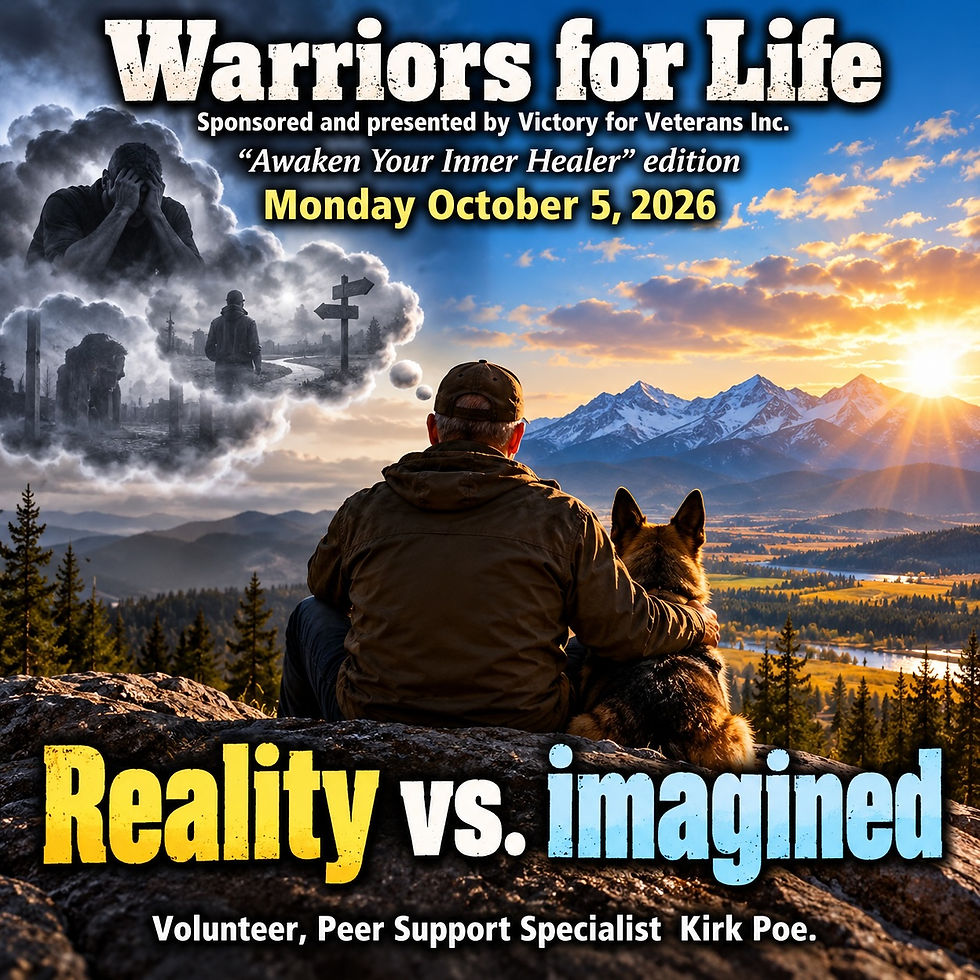
Come join Volunteer, Peer Support Specialist Kirk Poe for "Awaken Your Inner Healer!" edition of Warriors for Life (WFL) Online, sponsored and presented by Victory for Veterans, Inc. (VFV).
We are asking everyone to share who we are and what support Victory for Veterans provides via WFL. If you know someone who is a veteran, first responder or a family member/caregiver, please ask them to join us for at least one meeting so they can learn more about what we do and how they can share their wisdom with others who may be able to learn from them.

TONIGHT's Topic: "AI and DSM-5"

Join Kirk and Friends, TONIGHT and let's get together online for the Warriors for Life (WFL) as we talk about "AI and DSM-5
AI (Artificial Intelligence) involves machines mimicking human intelligence for tasks like learning and problem-solving, with potential in healthcare for diagnostics, while the DSM-5 (Diagnostic and Statistical Manual of Mental Disorders, 5th Edition) is the authoritative guide by the American Psychiatric Association for classifying mental health conditions, and AI is being explored to help apply its criteria more effectively, analyzing complex patterns to support clinicians in diagnosing disorders like those listed in the DSM-5.

Artificial Intelligence (AI)
Definition: Computer systems designed to perform tasks that typically require human intelligence, such as understanding language, recognizing patterns, and making decisions.
In Mental Health: AI uses machine learning and natural language processing (NLP) to analyze patient data (notes, speech) to help identify mental health conditions, personalize treatments, and offer accessible support via chatbots, complementing human care.

DSM-5 (Diagnostic and Statistical Manual of Mental Disorders, 5th Edition)
Definition: A handbook used by healthcare professionals to diagnose mental disorders, detailing criteria, symptoms, and related features.
DSM-5-TR: The current version includes Text Revisions (TR) with updated scientific information.

How AI & DSM-5 Interact
AI Augmentation: AI models can be trained on clinical notes and patient data to recognize patterns aligning with DSM-5 criteria, potentially offering faster, more objective diagnostic support to clinicians.
Challenges: The complexity and subjective nature of mental health, along with data privacy, have slowed AI adoption, but research shows promise in AI assisting with diagnoses like schizophrenia, PTSD, and bipolar disorder, improving early detection and treatment.
AI and the Diagnostic and Statistical Manual of Mental Disorders, Fifth Edition (DSM-5) interact primarily through AI's role as a powerful complementary tool for clinicians, enhancing diagnostic precision, personalizing treatment, and potentially contributing to the evolution of diagnostic criteria. AI is not currently a replacement for human expertise, as no FDA-approved AI applications currently exist for standalone psychiatric diagnosis.
AI's Role in Relation to the DSM-5
Enhancing Diagnostic Accuracy: The DSM-5 relies heavily on subjective patient reports and clinical observations. AI algorithms can process vast amounts of data, including patient records, neuroimaging, genetic information, and natural language processing (NLP) of clinical narratives, to identify subtle patterns and symptom clusters that might escape human observation. This helps augment, not replace, human diagnostic capabilities.
Personalizing Treatment: AI helps move beyond the "one-size-fits-all" model of treatment by analyzing an individual's unique data to predict which interventions (e.g., specific medications or types of therapy) are most likely to be effective.
Refining Diagnostic Criteria: By identifying new, data-driven patterns and potential subtypes of disorders (e.g., specific subtypes of depression based on sleep patterns or treatment response), AI research could inform future revisions of the DSM-5, potentially leading to more objective and granular diagnostic categories.
Improving Access and Monitoring: AI-powered tools like chatbots and mental health apps can provide accessible support and monitor symptoms in real-time, especially in underserved populations. This continuous monitoring helps in the early detection of symptom exacerbation or relapse, as defined by DSM-5 criteria.
Automating Administrative Tasks: Tools such as Microsoft's DAX Co-pilot use AI to capture patient stories and generate clinically relevant summaries and notes (e.g., SOAP notes), allowing mental health professionals to focus more on patient interaction and less on documentation.
Key Considerations and Challenges
Ethical Concerns: The use of AI in mental health raises significant ethical issues, including data privacy and security, algorithmic bias, and the need for transparency and interpretability in AI's decision-making processes.
Limitations: AI models face challenges with the complexity and subjective nature of mental health data. They must be carefully validated to ensure they are not overgeneralizing or perpetuating biases present in their training data.
Human Oversight is Crucial: Experts consistently emphasize that AI should be viewed as a supportive tool to enhance clinical decision-making, not a replacement for the compassionate and nuanced care provided by human professionals.
Warriors for Life (WFL) Online "Awaken Your Inner Healer!" edition presented by Victory for Veterans, Inc. (VFV) - Monday (TONIGHT), January 12, 2026 @ 4:30 PM PT, 5:30 PM MT, 6:30 PM CT, & 7:30 PM ET
Join Zoom Meeting: https://us06web.zoom.us/j/86121340012
Thank you,
Kirk Poe, Certified Peer Support Specialist, Reiki Master, Certified Body/Emotion/Belief Code Practitioner, & Volunteer Facilitator, Victory for Veterans, Inc. (VFV)


Comments