


Join Steven & Friends for "Change Your Frequency, Not Your Volume!" with Warriors for Life (WFL)

Join our Volunteer, Air Force Veteran, Peer Support Specialist/AdultTrainer, and Writer/Author Steven Bates TONIGHT for "Mid-Week Musings!" edition of Warriors for Life (WFL) Online, sponsored and presented by Victory for Veterans, Inc. (VFV).
We are asking everyone to share who we are and the support that Victory for Veterans, Inc. (VFV) is providing through Warriors for Life (WFL). If you know someone who is a veteran, first responder or a family member/caregiver, please ask them to join us for at least one meeting so they can learn more about what we do and how they can share their wisdom with others who may be able to learn from them.
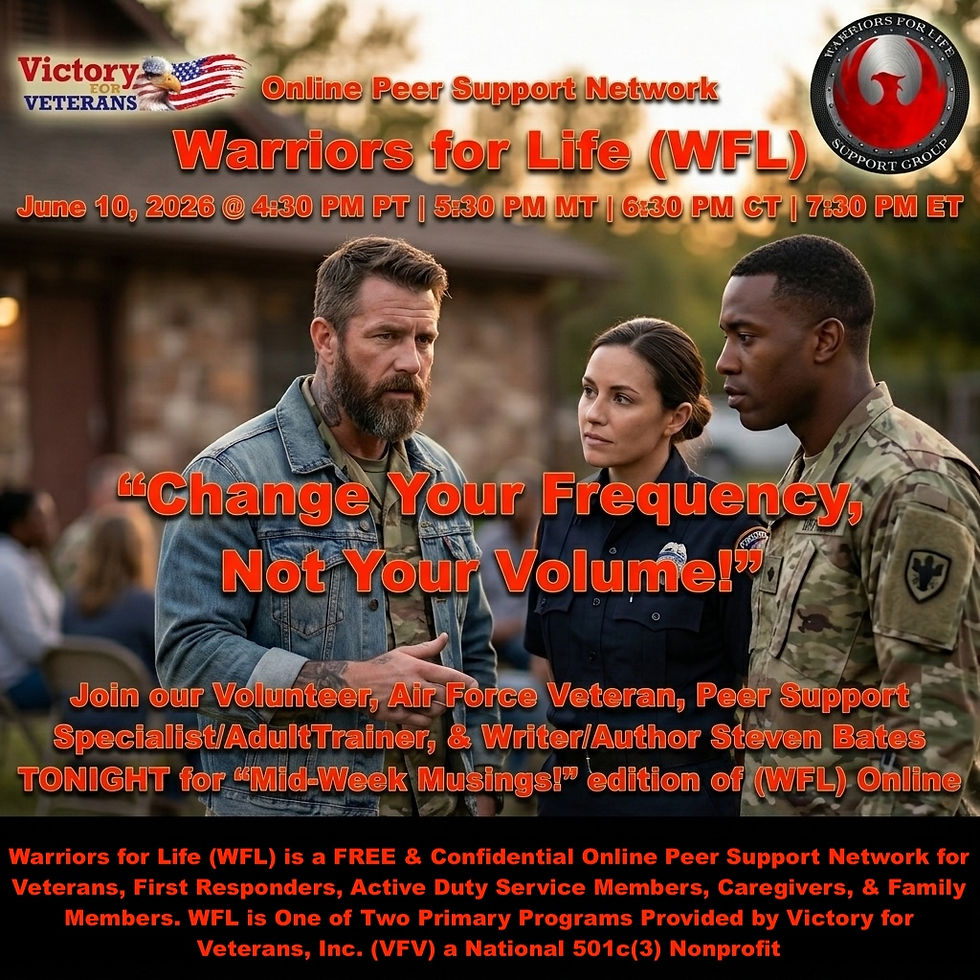
"Change Your Frequency, Not Your Volume!"
Welcome, everyone, to tonight’s edition of Warriors for Life (WFL): "Mid-Week Musings!" It is great to have you all here in our peer support network.
Our focus is a powerful concept: "Change Your Frequency, Not Your Volume!"

"FM radio. Used every day prolifically worldwide as a means of communication, entertainment, and enlightenment. But what do we know about FM versus AM radio? Why are all the radio stations on FM now?

On June 10, 1890, a one Edwin Howard Armstrong was born. He was a brilliant student, often challenging his teachers and even his professors at Columbia University in New York, where he graduated with an Electrical Engineering Degree in 1913. After graduation, he served during World War I in the Signal Corps. Eventually earning the rank of Major, Armstrong would turn his inventions over to the military to use freely. Howard Armstrong, looked for ways to improve communication signals to lessen interference from weather and external influences. In the days of AM radio, this was done by just boosting the power of the signal, or "modulating" its amplitude, hence the name, AM, or, Amplitude Modulation. Radio stations would be defined by how many watts of power they broadcast, such as advertising "Station (XYZ) with 50 watts of broadcasting power." Sadly, boosting the power didn't really help reduce interference. Armstrong vowed to improve that and developed a means called Frequency Modulation, or FM, where the modulation would be by changing the frequency of the carrier to match the audio signal. This revolutionized radio. Suddenly, a 40 Watt FM station could transmit farther and clearer transmissions than a 50-watt AM radio station. Major Armstrong, as he was often called, even in civilian life, had changed the world of radio. He even designed radio transmissions to finally bounce off the moon, a feat that had never been done before. So what does this veteran of World War I and his invention of FM radio teach us in mental health?"
As veterans, first responders, and active-duty service members, we are trained to operate with power, authority, and command. When we deal with mental issues, invisible wounds, or civilian life, we often default to that training during stressful conversations. When we feel unheard, we tend to increase our "volume" or "power"—we yell, demand, or push harder. But true communication requires connection, not force.
Tonight, we will discuss how stepping back, changing our approach, and modulating our "signal" can transform our relationships and help us actually be heard by our families, friends, and peers.
Air Force veteran, author, and Peer Support Specialist Steven Bates will discuss changing your frequencies tonight on the Warriors for Life Mid-Week Musings Peer Support Group, so Tune In and let's learn how to get our signals heard!
The Negative Effects of Yelling and Screaming

When we increase our volume instead of adjusting our approach, it creates severe barriers to communication:
Triggers Survival Mode: Yelling activates the fight-or-flight response in others, causing them to shut down or defend themselves rather than listen.
Drowns the Message: The emotional intensity of a scream completely masks the actual point you are trying to make.
Erodes Trust: Repeatedly raising your voice damages emotional safety, making family members or peers withdraw from you over time.
Exacerbates Invisible Wounds: For fellow veterans or service members, loud outbursts can inadvertently trigger their own trauma or PTSD symptoms.
Roadmap: How to Regulate Your Communication

To change your communication frequency tonight and in daily life, follow this structured approach:
1. Check Your Signal (Self-Awareness)
Before you speak, pause to evaluate your internal state. Are you responding out of anger, fear, or frustration? Recognize the physical signs of your volume rising—like a racing heart or clenched jaw—and use that as a cue to pause.
2. Match the Receiver (Audience Calibration)
In radio communication, both devices must be on the same frequency to talk. The same applies to people. Adjust your tone, body language, and vocabulary to match what the listener can actually absorb, especially when talking to civilian family members.
3. Modulate the Delivery (Tactical Pausing)
Lower your pitch and slow down your words. A calm, steady voice forces the other person to quiet down to hear you, effectively de-escalating the entire room.
Thank you all for opening up and sharing your experiences tonight. Changing a communication habit that was drilled into us during service is not easy. It takes immense strength to step back, swallow our pride, and change our frequency instead of just getting louder. Remember, a stronger signal isn't a louder one—it is a clearer one. By regulating our output, we protect our peace and strengthen the bonds with the people who matter most.

Warriors for Life (WFL) Online "Mid-Week Musings!" edition presented by Victory for Veterans, Inc. (VFV) — Wednesday (TONIGHT), June 10, 2026, @ 4:30 PM PT, 5:30 PM MT, 6:30 PM CT, & 7:30 PM ET
Join Zoom Meeting: https://us06web.zoom.us/j/87440882846
Thank you,
Steven Bates, Air Force Veteran, Writer/Author, Peer Support Specialist/Adult Trainer, & Volunteer Facilitator, Victory for Veterans, Inc.


Comments