


Join Steven & Friends TONIGHT for "Are You Listening?" with Warriors for Life (WFL)

Join our Volunteer, Air Force Veteran, Peer Support Specialist, and Writer/Author Steven Bates TONIGHT for "Mid-Week Musings!" edition of Warriors for Life (WFL) Online, sponsored and presented by Victory for Veterans, Inc. (VFV).
We are asking everyone to share who we are and what support that Victory for Veterans, Inc. (VFV) is providing via WFL. If you know someone who is a veteran, first responder or a family member/caregiver, please ask them to join us for at least one meeting so they can learn more about what we do and how they can share their wisdom with others who may be able to learn from them.

TONIGHT's Topic: "Are You Listening?"

"There's an old joke that goes something like this: 'My wife was complaining and nagging that I wasn't listening to her, at least that's what I thought she said,... I wasn't paying attention.' As patients, we often feel that way with our VA doctors, that they are too busy typing than listening and thus not hearing half of what our symptoms or complaints are. But what exactly is listening? What is it we want people to hear? How do we want them to react when we are actively talking to someone? It's often said that communication is a two-way street, but let's focus on the listening part for now. How can we improve our listening skills? What are the different types of listening?"

Listening is a fundamental, therapeutic tool for mental health, often providing more immediate relief than advice by fostering safety, trust, and validation. Active and empathetic listening reduces feelings of judgment, helps process distress, and strengthens relationships, which are critical for emotional well-being.
Key aspects of the importance of listening for mental health include:
Validation and Emotional Safety: Feeling truly heard and understood validates a person's emotions, reducing their sense of isolation or distress.
Building Trust: Active listening builds a secure, non-judgmental environment, which encourages individuals to open up, particularly during a mental health crisis.
Therapeutic Impact: It functions as a healing mechanism, often more effective than jumping to solutions, by allowing the speaker to feel supported rather than fixed.
Improved Understanding: It helps listeners grasp the true nature of a person's experience, which is essential for providing effective support.
Reduced Stress: For the listener, it can improve emotional regulation, while for the speaker, it lowers anxiety.
Listening is not just a polite social skill, but a crucial, active process that can significantly improve a person's mental state and sense of connection
Types of listening include informational (learning), critical (evaluating), empathetic (understanding emotions), and appreciative (enjoyment). Other types include discriminative (identifying sound cues), selective (hearing only specific parts), and active (fully engaging). These skills help improve communication and interpersonal relationships.

Here is a breakdown of the main types of listening:
Informational Listening (Listening to Learn): Focuses on understanding and retaining information, such as in lectures, training, or when learning a new concept.
Critical/Analytical Listening (Listening to Evaluate):
Involves analyzing the speaker's message, evaluating the logic, and determining the validity of arguments.
Empathetic/Therapeutic Listening (Listening to Understand): Focuses on the speaker’s feelings and emotions to provide support and build connection.
Appreciative Listening (Listening for Enjoyment): Done for pleasure, such as listening to music, a podcast, or a comedy show.
Discriminative Listening: The most basic form, which involves identifying the difference between sounds, tones, and nonverbal cues.
Selective Listening: A type of partial listening where the listener hears only what they want to hear or only information that supports their existing beliefs.
Active Listening: A comprehensive technique involving full engagement, understanding, responding, and remembering what the speaker says.
Reflective Listening: Involves listening to understand a person's feelings and then reflecting those feelings back to them to ensure understanding.
Biased Listening: Hearing what one expects or wants to hear, often based on preconceived notions.
Additionally, some frameworks define levels of listening, such as ignoring, pretending, selective, attentive, and empathetic.
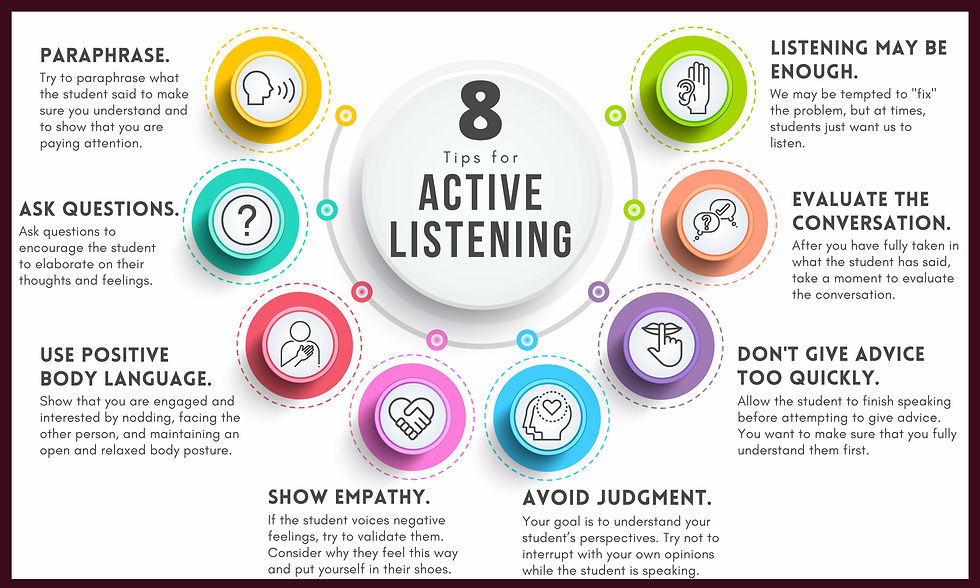
To improve listening skills, practice active listening by eliminating distractions, focusing on the speaker with open body language, and asking clarifying questions; also, summarize what you hear and provide feedback, while regularly engaging in focused listening exercises with podcasts or audiobooks for broader comprehension.
During Conversations (Active Listening)
Give Full Attention: Put away your phone, close your laptop, and make eye contact to show focus.
Listen, Don't Just Wait to Talk: Focus on understanding the speaker's message rather than planning your response.
Use Non-Verbal Cues: Nod, lean in slightly, and use facial expressions to show you're engaged.
Don't Interrupt: Let the speaker finish their thoughts before you speak.
Ask Open-Ended Questions: Use questions like "What was that like?" to encourage more detail, not just "yes/no" answers.
Paraphrase & Summarize: Repeat key points in your own words ("So, it sounds like you're saying...") to confirm understanding.
Empathize: Try to understand the speaker's feelings and perspective.
For Practice & Comprehension
Listen to Audio (Podcasts/Audiobooks): Listen to content slightly above your level, then listen again with a transcript to catch missed details.
Visualize: Create mental images of what the speaker is describing to improve retention.
Practice with Music: Pay attention to instruments, notes, and lyrics to build auditory focus.
Build Quiet Focus: Practice short bursts of intense listening to build mental stamina.
General Tips
Be Patient: Allow for pauses and silences in conversation.
Cultivate Curiosity: Be genuinely interested in what others have to say.

Join Air Force veteran, author, and Peer Support Specialist Steven Bates tonight with the Warriors for Life Mid-Week Musings Peer Support Group as we discuss the many aspects of listening and hearing in the act of communication with our peers and loved ones.
Warriors for Life (WFL) Online "Mid-Week Musings!" edition presented by Victory for Veterans, Inc. (VFV) — Wednesday (TONIGHT), February 11, 2026, @ 4:30 PM PT, 5:30 PM MT, 6:30 PM CT, & 7:30 PM ET
Join Zoom Meeting: https://us06web.zoom.us/j/87440882846
Thank you,
Steven Bates
Air Force Veteran, Writer/Author, Peer Support Specialist, &
Volunteer Facilitator, Victory for Veterans, Inc.


Comments