


Drop in TONIGHT with Derrick & Friends for a Discussion About the "Cat on a Hot Tin Roof!" with Warriors for Life (WFL)

Join our Volunteer, Army Veteran & Peer Support Specialist/Supervisor Derrick Iozzio TONIGHT for "Forever Forward!" edition of Warriors for Life (WFL) Online, sponsored and presented by Victory for Veterans, Inc. (VFV).
We are asking everyone to share who we are and the support that Victory for Veterans, Inc. (VFV) is providing through Warriors for Life (WFL). If you know someone who is a veteran, first responder or a family member/caregiver, please ask them to join us for at least one meeting so they can learn more about what we do and how they can share their wisdom with others who may be able to learn from them.

"Cat on a Hot Tin Roof!"
Join Derrick and friends TONIGHT for "Cat on a Hot Tin Roof!" A comprehensive discussion about Anxiety and Mental Health.
📣 Welcome to tonight’s "Forever Forward!" edition of Warriors for Life (WFL). Tonight, we are diving into a raw, honest, and critical discussion about anxiety and mental health.

For our veterans, first responders, and active-duty service members, anxiety is not just a feeling of worry. It is a constant, exhausting state of high alert. Imagine walking barefoot across a tin roof baking under a blistering sun. Every step burns. You cannot stand still, you cannot find a safe place to rest your feet, and you are constantly balancing on the edge of a collapse.
For those living with the invisible wounds of service, life can feel exactly like being a "Cat on a Hot Tin Roof." You are jumpy, hyper-vigilant, and trapped in a state of perpetual tension, desperate for a cool place to land. Tonight, we break down that tension, share our experiences, and look at how we can move forward together.
Group Discussion Question: What does walking on a "hot tin roof" look like in your daily life? What triggers that sudden heat for you?
The Root of the Heat: MST, PTSD, TBI, and Invisible Wounds

Anxiety rarely exists in a vacuum. For this community, it is often fueled by deep, complex underlying trauma. Here is how these invisible wounds crank up the heat:
Military Sexual Trauma (MST): MST shatters the foundational element of survival: trust. When the threat comes from within your own unit or circle, your internal radar breaks. The resulting anxiety is a constant, agonizing scanning of every room and every person, wondering if you are truly safe.
Post-Traumatic Stress Disorder (PTSD): PTSD locks the brain's alarm system (the amygdala) into the "ON" position. The hot tin roof becomes a permanent reality because your brain convinces you that a mortal threat is always imminent, turning everyday grocery trips or traffic jams into life-or-death battlegrounds.
Traumatic Brain Injury (TBI): Physical damage to the brain alters emotional regulation pathways. When a TBI impacts the frontal lobe, the brain struggles to filter out noise, light, or stress. This cognitive overload directly sparks intense, unpredictable physical surges of anxiety.
Moral Injury: Witnessing or participating in actions that violate your deeply held moral beliefs creates a profound internal conflict. This manifests as an anxious dread of judgment, severe guilt, and the feeling that you no longer belong in a normal world.
Group Discussion Question: For those comfortable sharing, how do your invisible wounds act as the "fuel" that keeps your anxiety burning?
The Toll: Common Effects of Anxiety

Anxiety is a full-body experience. It drains your battery from the moment you wake up until the moment you pass out from exhaustion.
Physical Effects
Hyper-vigilance: Constantly scanning perimeters, sitting facing the door, and a severe startle reflex.
Body Tension: Chronic muscle aches, migraines, clenched jaws, and gastrointestinal distress.
Sleep Deprivation: Insomnia driven by a racing mind or the dread of recurring nightmares.
Psychological & Behavioral Effects
Emotional Numbing: Shutting down feelings entirely to keep the overwhelming anxiety from breaking through.
Irritability and Anger: Anxiety often wears a mask of rage; a sudden outburst is frequently just panic looking for a way out.
Isolation: Avoiding crowds, friends, and family because the effort required to mask the anxiety is too draining.
Group Discussion Question: Does your anxiety usually show up as a physical symptom, like a racing heart, or an emotional symptom, like anger? How do you recognize it early?
Cooling the Roof: Self-Care and Overcoming Anxiety

While you cannot always control the external triggers, you can learn how to cool down the roof beneath your feet.
Box Breathing: When panic hits, take control of your nervous system. Inhale for 4 seconds, hold for 4, exhale for 4, hold for 4. This forces your heart rate down and signals to your brain that you are safe.
The 5-4-3-2-1 Grounding Method: Pull yourself out of a trauma loop and back into the present room. Name 5 things you can see, 4 things you can touch, 3 things you can hear, 2 things you can smell, and 1 thing you can taste.
Radical Acceptance & Pacing: Acknowledge the anxiety without judging yourself for it. If the roof is hot today, step into a shaded area. Shorten your goals to the next hour, or even the next five minutes.
Routine as Armor: Establish a rigid morning and evening routine. Predictability is the natural enemy of anxiety.
Group Discussion Question: What is one go-to tool or trick you use to ground yourself when you feel your feet starting to burn?
Guarding the Perimeter: How Caregivers Can Help
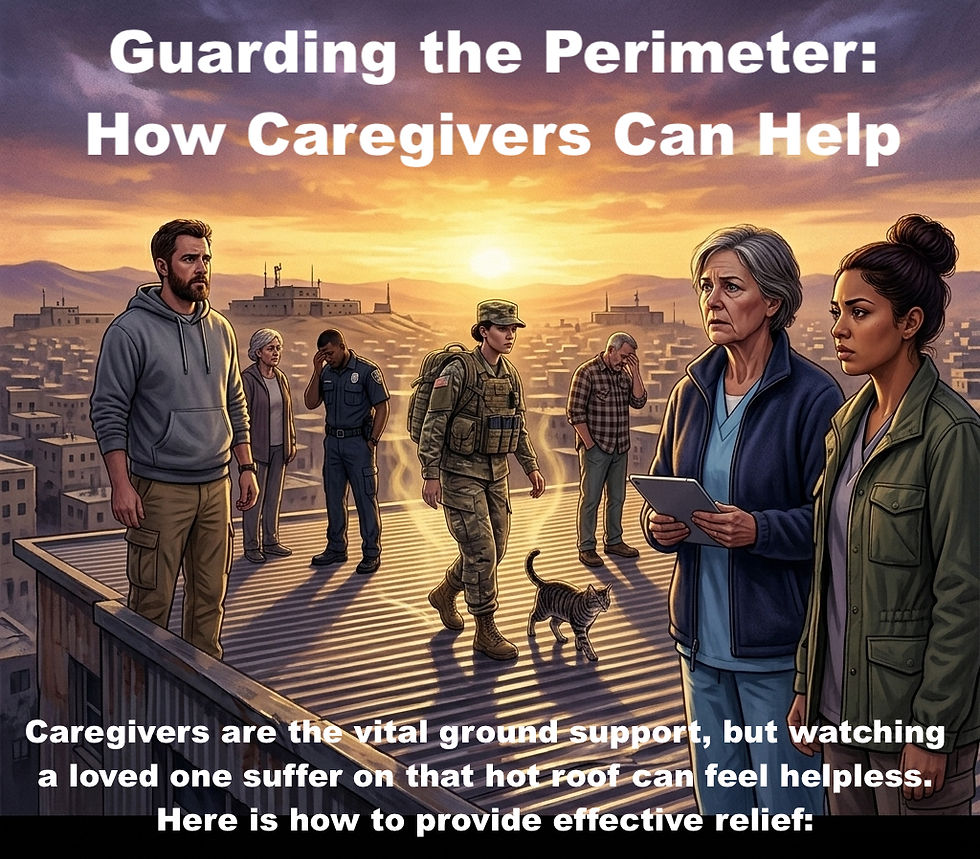
Caregivers are the vital ground support, but watching a loved one suffer on that hot roof can feel helpless. Here is how to provide effective relief:
Establish a "Safe Harbor" Environment: Create a home space that is low-stimulus. Reduce loud noises, sudden movements, and chaotic scheduling. Predictability at home lowers baseline anxiety.
Validate, Don't Fix: Avoid saying "just calm down" or "there is nothing to worry about." Instead, say: "I see you are in a tough spot right now. I am right here with you. What do you need from me?"
Co-Regulate: When they panic, your calm can become theirs. Keep your voice low, your breathing slow, and your presence steady. Do not match their high energy with panic or frustration.
Protect Your Own Battery: Y ou cannot pour from an empty cup. Caregivers must maintain their own support systems to avoid secondary traumatic stress.
Group Discussion Question: Caregivers, what is the hardest part about supporting someone through an anxiety spike? Warriors, what do you wish your loved ones understood most during those moments?
Warriors, as we close out tonight’s session of Warriors for Life, look around this virtual room. Look at the names and the faces next to you. If you have been tip-toeing through life, burning your feet, feeling like you are entirely alone on that hot tin roof—look at this line-up. Every single person here knows the heat of that sun. Every person here has felt that panic. You do not have to walk it alone anymore. The roof might still be hot tomorrow, but tonight, we share the weight, we pass down the boots, and we help each other find the shade.

Warriors for Life (WFL) Online "Forever Forward!" edition presented by Victory for Veterans, Inc. (VFV) — Thursday (TONIGHT), June 11, 2026, @ 4:30 PM PT, 5:30 PM MT, 6:30 PM CT, & 7:30 PM ET
Join Zoom Meeting: https://us06web.zoom.us/j/81682532691
Thank you,
Derrick Iozzio, Army Veteran, Peer Support Specialist/Supervisor, Catch 22 Peer Support Founder, & Volunteer Facilitator, Victory for Veterans, Inc. (VFV)


Comments