


Join Steven and Friends TONIGHT for "Handling Disappointment!" with Warriors for Life (WFL)

Join our Volunteer, Air Force Veteran, Peer Support Specialist/AdultTrainer, and Writer/Author Steven Bates TONIGHT for "Mid-Week Musings!" edition of Warriors for Life (WFL) Online, sponsored and presented by Victory for Veterans, Inc. (VFV).
We are asking everyone to share who we are and the support that Victory for Veterans, Inc. (VFV) is providing through Warriors for Life (WFL). If you know someone who is a veteran, first responder or a family member/caregiver, please ask them to join us for at least one meeting so they can learn more about what we do and how they can share their wisdom with others who may be able to learn from them.
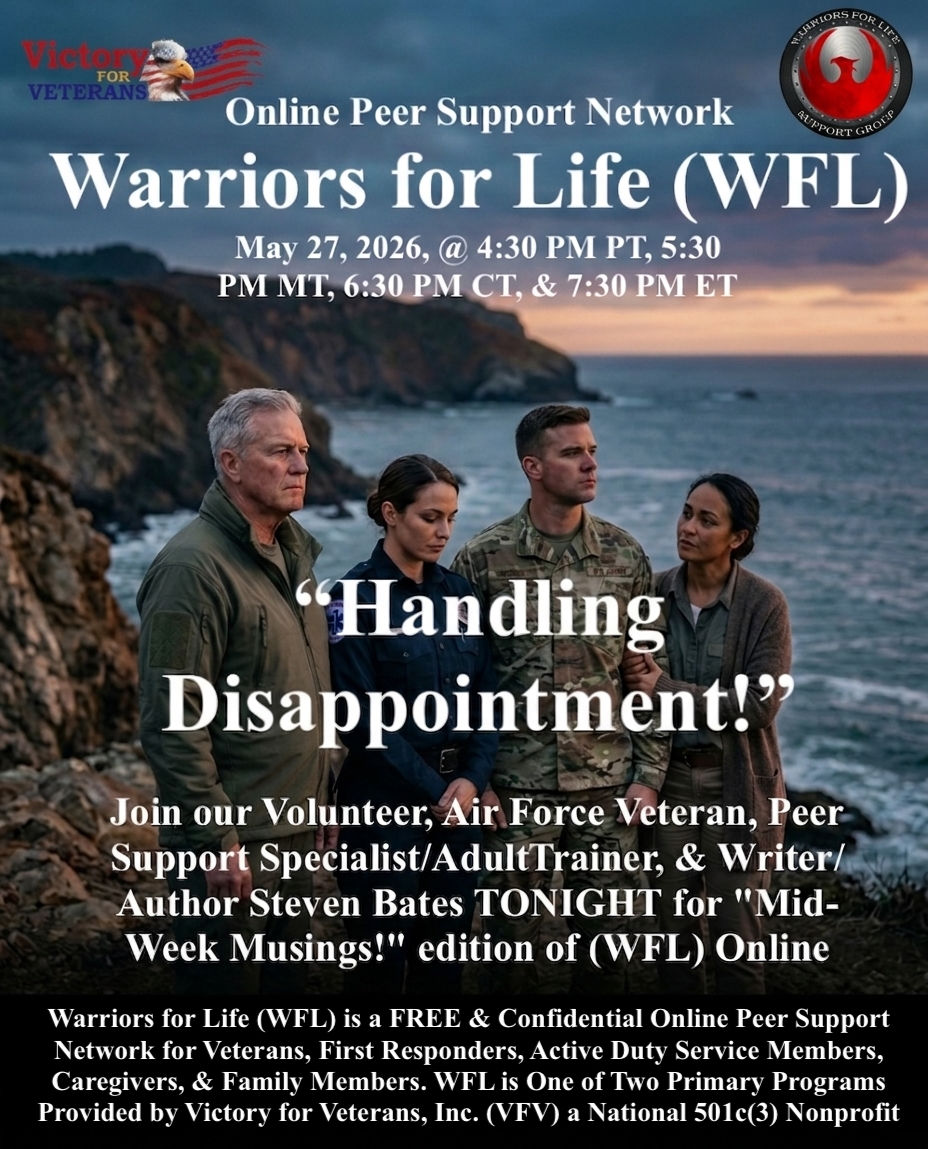
"Handling Disappointment!"

"Disappointment. We all get it at some time or another. In fact, when my computer was questioned as to the ratio of disappointment in persons versus the ratio of satisfaction, it stated the studies show that the ratio of the former is roughly equal to or slightly higher than the latter. So if it is so prevalent in our lives, how are we supposed to handle it efficiently, effectively, and effortlessly? How do we manage disappointment to the point where he does not override our emotional health and well-being and cause depression? What are some methods to handling disappointment when we find it in our lives as opposed to finding satisfaction? Can we manage handling our disappointment as well as we handle being satisfied in most situations?"
Overcoming the Weight of Disappointment: A Guide for Warriors, First Responders, and Caregivers
Handling disappointment is one of the greatest challenges to our emotional health. For veterans, first responders, active-duty service members carrying invisible wounds, and the caregivers who support them, disappointment can feel amplified. When life constantly misses the mark, it can lead directly to burnout, anxiety, and depression.
While handling disappointment completely "effortlessly" is impossible—because processing emotion always requires some energy—we can learn to manage it efficiently and effectively.
Welcome, Warriors, First Responders, Caregivers, and Supporters, to tonight’s edition of "Midweek Musings!"
Every single one of us has a roadmap in our minds for how our lives, our careers, our health, and our relationships are supposed to go. But what happens when that roadmap leads us straight into a dead end?
Disappointment is a universal human experience, but for this community, it hits differently. When you are dealing with the aftermath of trauma, chronic illness, transition challenges, or the grueling daily grind of caregiving, disappointment isn't just a minor letdown. It can feel like a direct threat to your hard-earned stability. It is the gap between what you expected and the reality you are forced to face.
Tonight, we are pulling back the curtain on this heavy emotion. We will explore how invisible wounds change the way we process setbacks, how caregivers can survive the crushing weight of unmet expectations, and practical, battle-tested strategies to handle disappointment before it spirals into depression. Grab your coffee or tea, lean into the chat, and let’s tackle this together. You are not alone, and your story matters.
Disappointment and Invisible Wounds (Veterans & First Responders)

For individuals living with Post-Traumatic Stress (PTS), Traumatic Brain Injury (TBI), moral injury, or operational stress, disappointment triggers a heightened neurological response.
The Threat Response
A healthy brain registers disappointment as an inconvenience. A brain altered by trauma often registers it as a threat or a failure. When a plan falls through, the nervous system can instantly misinterpret the situation as unsafe, sending the individual into a fight, flight, or freeze state.
Cognitive Distortions
Invisible wounds frequently warp reality through "all-or-nothing" thinking. If a job interview fails, a VA claim is denied, or a medical treatment doesn't work, the mind labels it as: "Nothing ever works out for me," or "I am a failure." This rapid downward spiral bypasses normal logic, making the disappointment feel permanent and pervasive.
Identity Loss
Many service members and first responders are hardwired to solve problems and win. When they encounter situations they cannot fix—like bureaucratic delays, physical limitations, or broken relationships—it causes a massive crisis of identity and purpose, deepening the emotional wound.
The Caregiver’s Burden of Disappointment

Caregivers operate in an environment where disappointment is practically built into the daily routine. They manage it under immense, prolonged pressure, which changes the stakes entirely.
Chronic Grief and Expectations
Caregivers often grapple with the disappointment of a altered future. They must constantly adjust their expectations regarding their loved one's recovery, independence, and behavior. Watching a spouse, parent, or child struggle creates a cycle of chronic grief disguised as daily disappointment.
The Self-Care Paradox
Caregivers frequently face disappointment from their own support systems. Friends drift away, family members fail to step up, and medical systems cause endless frustration. This isolation forces the caregiver to absorb the disappointment alone, driving them closer to compassion fatigue.
The Illusion of Control
Many caregivers fall into the trap of believing that if they just work harder, research more, or sacrifice more sleep, they can force a positive outcome. When reality fails to match their immense effort, the resulting disappointment turns inward as guilt and self-blame.
Methods for Handling Disappointment Effectively

To prevent disappointment from overriding your emotional health and causing depression, you must implement proactive, structured emotional tactics.
[Disappointment Occurs]
       │
       ▼
[Acknowledge & Validate] ──► Name the exact feeling (No toxic positivity)
       │
       ▼
[The 24-Hour Rule]       ──► Allow limited time to feel the sting
       │
       ▼
[Audit Expectations]     ──► Separate facts from assumptions
       │
       ▼
[Shift to Agency]        ──► Pivot focus strictly to what you can control
Practice the 24-Hour Rule: Allow yourself a specific window of time (e.g., 24 hours) to be angry, sad, or frustrated. Cry, vent to a trusted friend, or write it down. When the timer hits zero, consciously shift your focus from how you feel to what you can do next.
Audit Your Expectations: Disappointment cannot exist without a prior expectation. When you feel let down, ask yourself: Was my expectation realistic? Was it based on facts, or on what I desperately wanted to happen? Adjusting expectations is not giving up; it is tactical reassessment.
Ruthlessly Separate Control from Influence: Draw two columns on a page. Write down what you can control in one column (your attitude, your next phone call, your sleep, your boundaries). Write what you cannot control in the other (other people, bureaucratic decisions, the weather, past events). Throw away energy spent on the second column.
Ban Toxic Positivity: Do not try to force a smile or say "everything happens for a reason" when you are hurting. Acknowledge the pain directly. Saying "This situation is incredibly unfair and I am furious" is far healthier than burying it under fake optimism.
Disappointment vs. Satisfaction: Can We Balance Both?

Can we handle disappointment as smoothly as we handle being satisfied? The short answer is no, but we can close the gap.
The Brain's Negativity Bias
Human biology is wired to survive, not to be happy. Your brain naturally prioritizes negative experiences (disappointment) over positive ones (satisfaction) because threats keep you alive, while wins do not [1]. It takes conscious, repetitive mental conditioning to balance the scales.
Redefining Satisfaction
We easily handle satisfaction because it requires nothing from us; it validates our desires. To handle disappointment just as well, we must stop viewing it as the opposite of satisfaction. Instead, view disappointment as data. It tells you what matters to you, where your boundaries are, and when a strategy needs to change.
Developing Radical Acceptance
True emotional resilience means accepting reality exactly as it is in the present moment, without judging it or wishing it were different. When you can look at a disappointing outcome and say, "This is not what I wanted, but this is what is happening," you stop fighting reality. That shifts you out of suffering and into problem-solving mode.
As we wrap up our discussion on this heavy but vital topic, remember this: Disappointment is an event; it is not your identity.
For our warriors carrying invisible wounds, your heightened reaction to letdowns is a biological response to past trauma, not a sign of weakness. For our caregivers, your feelings of exhaustion and frustration when things go wrong are entirely justified proof of how deeply you care.
We cannot live a life completely free of disappointment. It is the tax we pay for giving a damn, for trying, and for putting ourselves out there. But we absolutely can prevent that disappointment from settling into our bones and turning into depression. We do that by lowering our unrealistic expectations, raising our radical acceptance, and leaning heavily on one another. You don't have to carry the weight of a broken plan all by yourself.
Call to Action!

Thank you for being here tonight, for sharing your hearts, and for standing in the gap for one another. Keep fighting the good fight, take care of your mental baseline, and we will see you right here next week. Goodnight, and stay strong!

Warriors for Life (WFL) Online "Mid-Week Musings!" edition presented by Victory for Veterans, Inc. (VFV) — Wednesday (TONIGHT), May 27, 2026, @ 4:30 PM PT, 5:30 PM MT, 6:30 PM CT, & 7:30 PM ET
Join Zoom Meeting: https://us06web.zoom.us/j/87440882846
Thank you,
Steven Bates, Air Force Veteran, Writer/Author, Peer Support Specialist/Adult Trainer, & Volunteer Facilitator, Victory for Veterans, Inc.


Comments